

It’s Saturday at home. The phones get collected.
Everyone agrees to the plan.
But then the world keeps buzzing anyway.
The restaurant menu is a QR code. Homework assignments are posted in a parent portal.
The carpool group text needs a response. Snapchat stories need checking. Ordering pizza means DoorDash.
Even when kids aren’t on their phones, they’re still living in a world designed around screens. The infrastructure assumes the device. The systems require it.
A tech-free Saturday is possible. But it’s like trying to eat healthy while living inside a candy store. The store is still designed for sugar. And our world is still designed for phones.
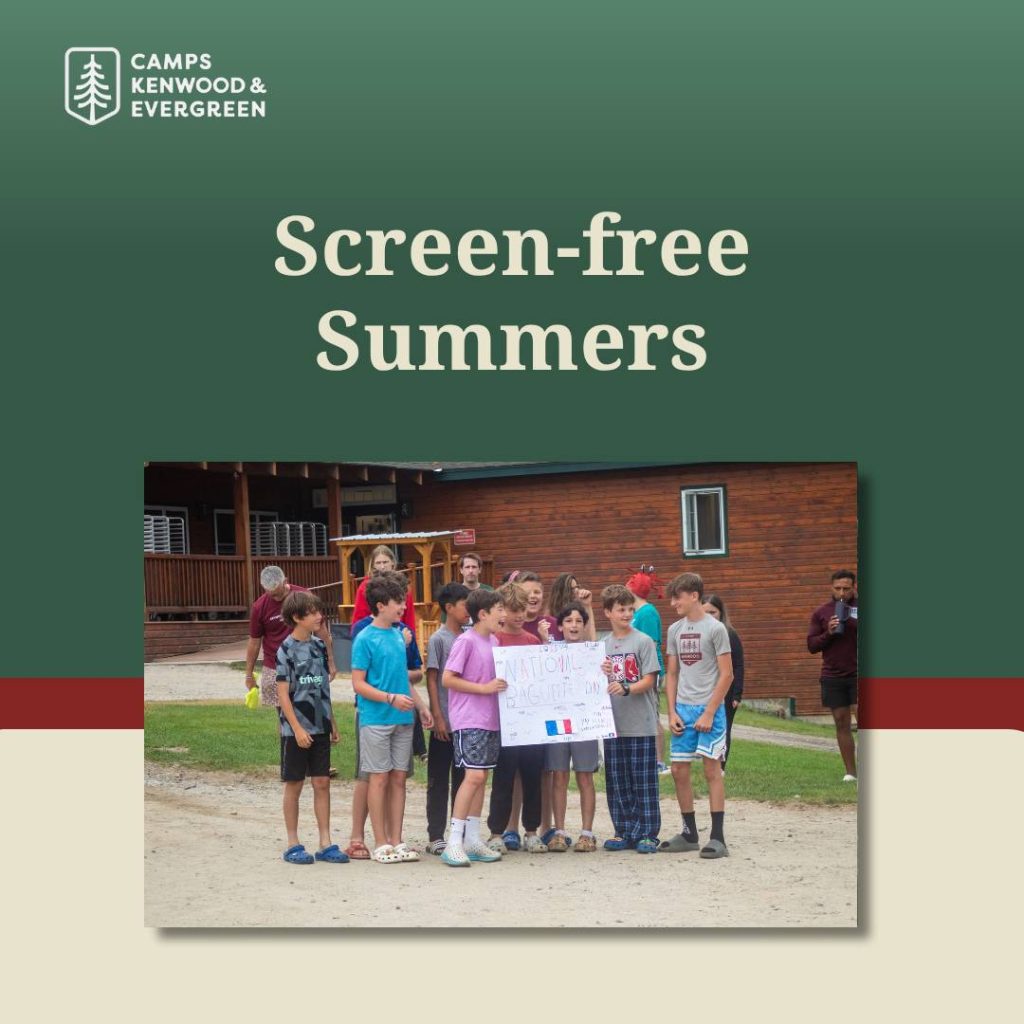
Camp doesn’t just remove devices. It removes the entire infrastructure that makes them necessary.
A World That Never Needed Screens
Most “phone breaks” happen inside phone-dependent environments. Take away the device → systems stay the same.
At camp, the systems were built differently from the start.
Printed schedules. Live announcements. Bulletin boards.
Every single system at K&E (meals, activities, campfires, free time) was designed decades before smartphones existed. And drumroll please… still works perfectly.
Kids aren’t resisting the pull of their phones. Their phones literally have nothing to offer them there.
The world outside camp is increasingly phone-dependent.
Camp is phone-irrelevant.
6.5 Weeks
A tech-free weekend is so tough because there’s a lot of “What am I missing?!”
Notifications are piling up. They’ll all get checked Sunday night anyway.
A one-week digital “detox” (not my word, but I’ve seen camps use this)? Better. But kids know their phones are waiting. The countdown is on.
A full summer is different.
Some adjustment at first, sure. But it doesn’t take long for kids to stop thinking about their phones. The real mega-win? The sheer amount of time without them.
With time, that mental reach for the device dissolves.
No notifications. No refreshing. No performance anxiety about how a moment will look in the group chat. None of that constant low-grade buzzing that someone might be buzzing them, posting about them, leaving them out.
For basically the entire summer, their brains get to just be present.
This is going to sound sales-pitchy, but it’s also just true.
Most places can’t offer this.
One-week camps can’t create that depth of change.
School breaks are typically more of a chance to just veg out. And even most adults can’t replicate it for themselves. I know I struggle for sure. Try going without a phone for a single workday and see how quickly things hit the fan.
At camp, it’s not a challenge or an experiment.
When I interviewed Seth Godin, he called this “People like us do things like this.”
At camp, it is just how summer works.
What We’re Learning (And Want to Measure)
My friend Andy Schlensky (North Star Camp owner) and I are always low-level asking: What if we could measure the change?
Look at a kid’s brain activity right before camp started, and then again after 6.5 weeks?
No data on this, but just look at what’s happening in those weeks:
Almost two months fully immersed in nature. Surrounded by pro-social (read face-to-face) relationships every single day. Zero screen time by design.
Kids’ brains just have to light up in completely different ways.
No demonizing tech. Phones aren’t evil. Social media isn’t the enemy.
But camp is all about kids remembering what their brains feel like when they’re not constantly pinged.
Why This Counts
Phones aren’t disappearing. School, sports, friendships, and social life are all increasingly digital. That’s reality, and it’s 100% fine.
But for 6.5 weeks, kids get to live in a place that works without screens.
Not as a dramatic statement about technology. Just because camp works way better that way, and it just happens to be better for everyone in the process.
I hear all the time from parents that when camp friends get together outside of camp, there’s waaaay less phone time because they know how to just be together.
That’s rare. Maybe the rarest thing a camp can offer right now.
And it matters.
Summer Matters.
Jack
PS – Want to talk about these screen-free summers? Click this
Calendly link to schedule a chat with me.
PPS – Almost final call here. Everyone who enrolls by Nov 1st (still time!) will get a K&E hoodie.

Jack Schott
[email protected]
585-451-5141 (text me)
114 Eagle Pond Rd, Wilmot, NH 03287
Camps Kenwood & Evergreen Snapshot
- Location: New England overnight summer camp
- Philosophy: Growth through community, independence, and belonging
- Structure: Unified camp mission with gender-specific campuses
- Outcomes: Confidence, leadership, friendship, identity growth


